
The Penrose Steps and Wayne Gretzky
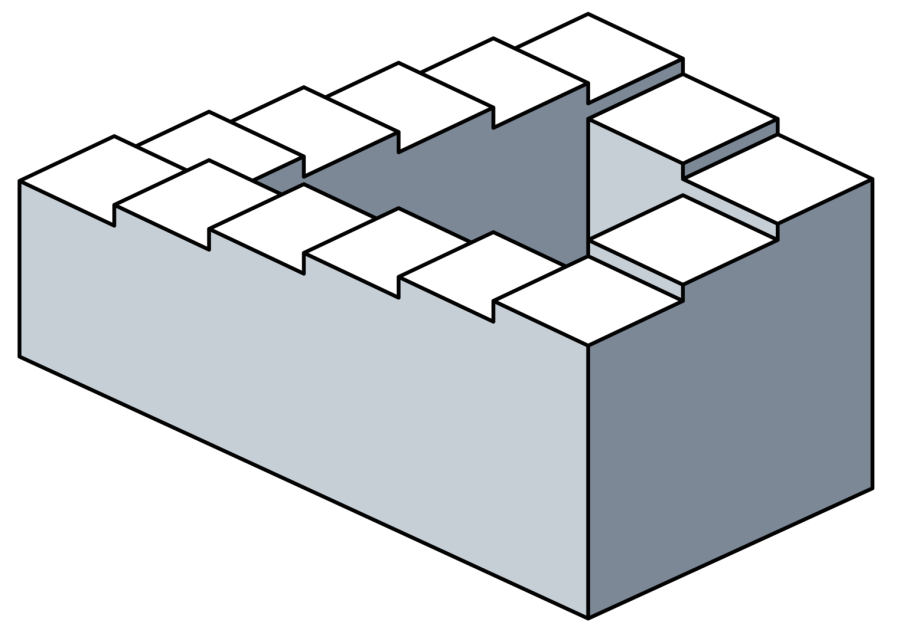
Lionel Penrose, a physician, geneticist, and psychiatrist, and his son Roger Penrose, a mathematician and physicist (later Nobel Prize–winning for work on black holes), introduced a concept in 1958 called “impossible objects.” It wasn’t an art project, but a more serious look at human perception, logic, and impossible structures.
Today, we know it as The Penrose Staircase….which goes on to explain how human perception can be internally consistent and still fundamentally wrong at the system level. In terms of financial planning, it demonstrates how a system can follow logical steps indefinitely without ever achieving real progress — a perfect analogy for how modern financial planning treats longevity without modeling dependency, or the need for Long-Term Care (LTC).
If you break financial services into core competencies, you find six primary planning disciplines, including retirement, investments, estate, risk, Medicare/insurance, and tax planning. All are walking the Penrose Steps with clients, and most are getting nowhere to address what happens when longevity and dependence collide. That collision point is when retirement becomes execution, investments become liquidation, estate plans lack timing, the risk mitigation is missing, Medicare reveals exclusions, and tax efficiency collapses under cash-flow stress. Each discipline is still “doing its job,” and the consumer is actually in a worse position: Stuck in the structural blind spot of modern financial planning.
Metaphorically, it’s like a coach (the Consumer) on the bench in hockey, yelling “shoot the puck, shoot the puck” in the final 20 seconds of the game……
To that end, Wayne Gretzky, considered the greatest hockey player ever, famously said that you miss 100% of the shots you don’t take. In consumer financial planning, he’s essentially discussing LTC Planning, as study after study indicates the low percentage of Americans have anyone in their advisory structure willing to take that shot!
Perhaps the most glaring problem is that a consumer’s planning must identify ‘the who’ with respect to care delivery, care management, or care diagnosis, but fails to identify ‘who’ should be responsible FOR the planning. Rhetorically, it would be easy to put all six of the previously mentioned planning disciplines on a hockey rink and assign them as forwards, defensemen, and goalies, but that fails because accountability passes as the puck moves from one to another to another.
The coach on the bench keeps yelling “shoot the puck”, and no one is listening……
20260102
 Print
Print