
Having Assets Doesn’t Close The Care Delta
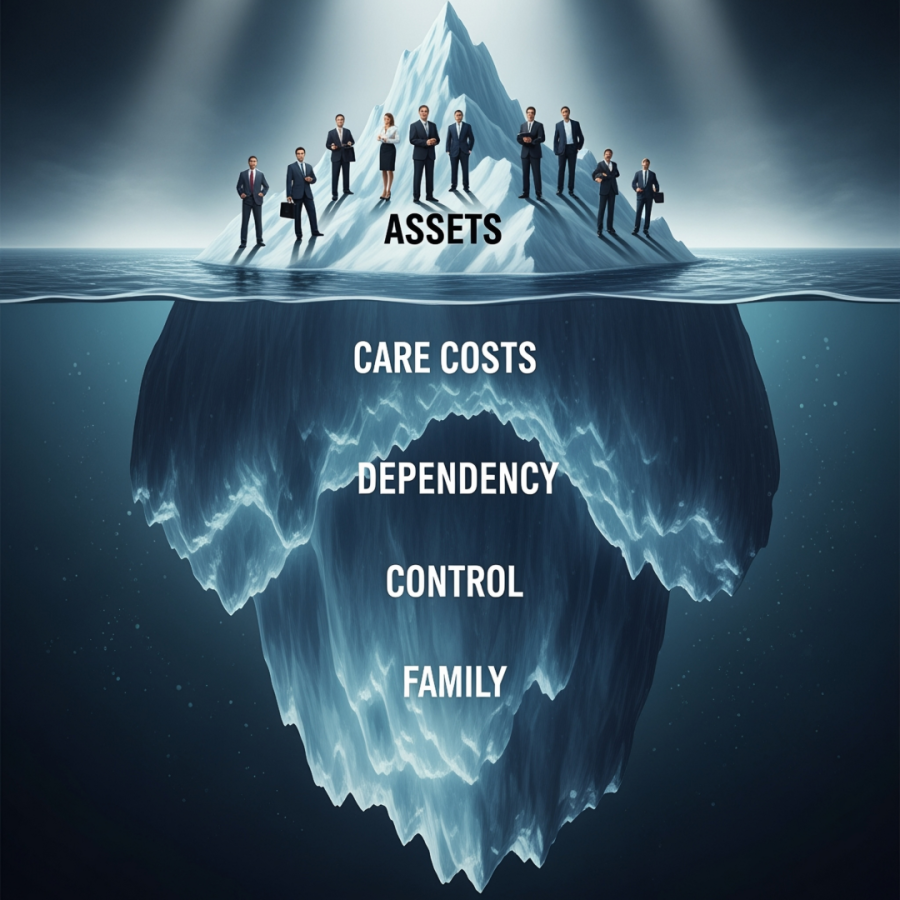
Financial planning focuses on many things, but a client’s health (asset) and future care needs (liability) are rarely one of them. And that omission is set to break the financial planning for millions of Americans.
Simply put, health is an asset….until the instant it isn’t.
As long as a client is independent, the health quietly subsidizes everything.
Your client spends less
Their family isn’t involved.
They stay in control
Life works.
But, as Moshe Milevsky puts it, “Health is a fundamental component of human capital” because the moment you lose the ability to live independently — whether through dementia or physical decline — that invisible asset collapses. Overnight. Instantly. There is no warning and no grace period.
This is the healthcare inversion point: One day you’re fine. The next day, you need help. And when that flip happens, it turns on the single largest unfunded liability in retirement. In accounting terms, health loses its value, and the unfunded liability of healthcare immediately appears on the personal balance sheet.
The difference between those values is the “Care Delta (Δ)” …..
The delta exists because of timing, leverage, liquidity, sequence risk, cognitive decline, family burden, and the absence of a mechanism to deploy assets at the moment independence is lost. While affluence helps with options, it does not eliminate:
- Unpredictable timing >>> No one knows when care starts!
- Unbounded duration >>> No one knows how long it lasts!
- Sequence-of-returns risk >>> Assets may be down 20–40% when care begins!
- Liquidity constraints >>> Affluent DOES NOT EQUAL Liquid!
- Portfolio drag >>> Funding care accelerates depletion!
- Tax friction >>> Large withdrawals trigger penalties elsewhere!
- Family chaos >>> Wealth doesn’t coordinate/manage care!
- Cognitive impairment >>> You can't self-fund when you can’t self-direct!
- The underwriting window >>> Once health collapses, options are lost!
Wealthy people misjudge the delta for a simple reason: They confuse “having money” with “having a mechanism.”
They assume assets equal preparation, but assets don’t price care, hedge timing, coordinate care, deliver tax-efficient liquidity for care, protect the portfolio, provide a care multiplier, arrive automatically at the onset of crisis, reduce family burden, replace lost independence, or prevent forced liquidation. No asset — not even $20M — performs those functions without help.
Wealth cannot close the Delta because the Delta is created by sequence, structure, unpredictability, and biology, not by lack of capital, and affluent clients are exposed to even more Delta risk because the higher your portfolio value, the bigger the tax consequences, the worse the sequencing damage, and the more catastrophic the compounding effect of withdrawing care-level cash flows from a portfolio during a down market.
Money amplifies the consequences, and wealthy families also face:
- Bigger estates to erode
- More properties to liquidate
- More complexity to unwind
- More friction among heirs
- More legal exposure
- More reputational risk in family businesses
And here’s the truth your most affluent clients will hate: If wealth alone closed the Delta, wealthy people wouldn’t end up in the exact same care crisis patterns as everyone else.
But they do. Every day. Because the Care Delta is not caused by being underfunded – It’s caused by being unprepared.
Wealth without leverage, liquidity, tax control, and timing control is still just… wealth. And at the healthcare inversion point, wealth is a blunt instrument. This is why every wealthy American, even the mass affluent, use sophisticated risk-management tools to prevent a delta between A and B from opening at the wrong time.
- Options close the delta to cap downside loss, preserve upside.
- Swaps and hedges neutralize the delta for timing.
- Trusts structurally reduce various legal and tax deltas.
- Diversification helps compress the delta.
- Insurance wrappers, when all else fails, transfer the delta elsewhere.
No one dismisses a trust because attorneys are paid to draft them.
No one condemns options because market makers earn a spread.
No one questions diversification because advisors charge a fee to implement it.
These tools are widely accepted — even encouraged — because they are understood as mechanisms that close specific risk gaps, not products to be judged by who gets compensated. Insurance is the lone exception because it is the only financial mechanism treated as morally suspect — not because it’s ineffective, but because risk transfer itself is misunderstood.
That tells you the objection has nothing to do with cost, math, efficiency, or fiduciary reasoning. It’s bias posing as sophistication that prevents 86% of Americans from failing the last gap closure test of purchasing insurance, that is failed planning and often failed Best Interest and fiduciary duty for discouraging a necessary mechanism to shrink the Delta before the inversion occurs. The failure to implement insurance-based planning is no different than using options, swaps/hedges, trusts, and diversification.
That excuse ends now…..
20251209
 Print
Print